
The amount printed on a loan approval is not always the amount that reaches your bank account. A loan origination fee can reduce the proceeds before the lender sends the money. This matters when you are borrowing for a specific bill or payoff amount.
A loan origination fee is a charge associated with making the loan. Depending on the lender and product, it may cover processing, underwriting, funding, or administrative work. The amount of the fee and how it is collected depend on the lender and the loan terms.
How a Loan Origination Fee Can Change the Amount You Receive
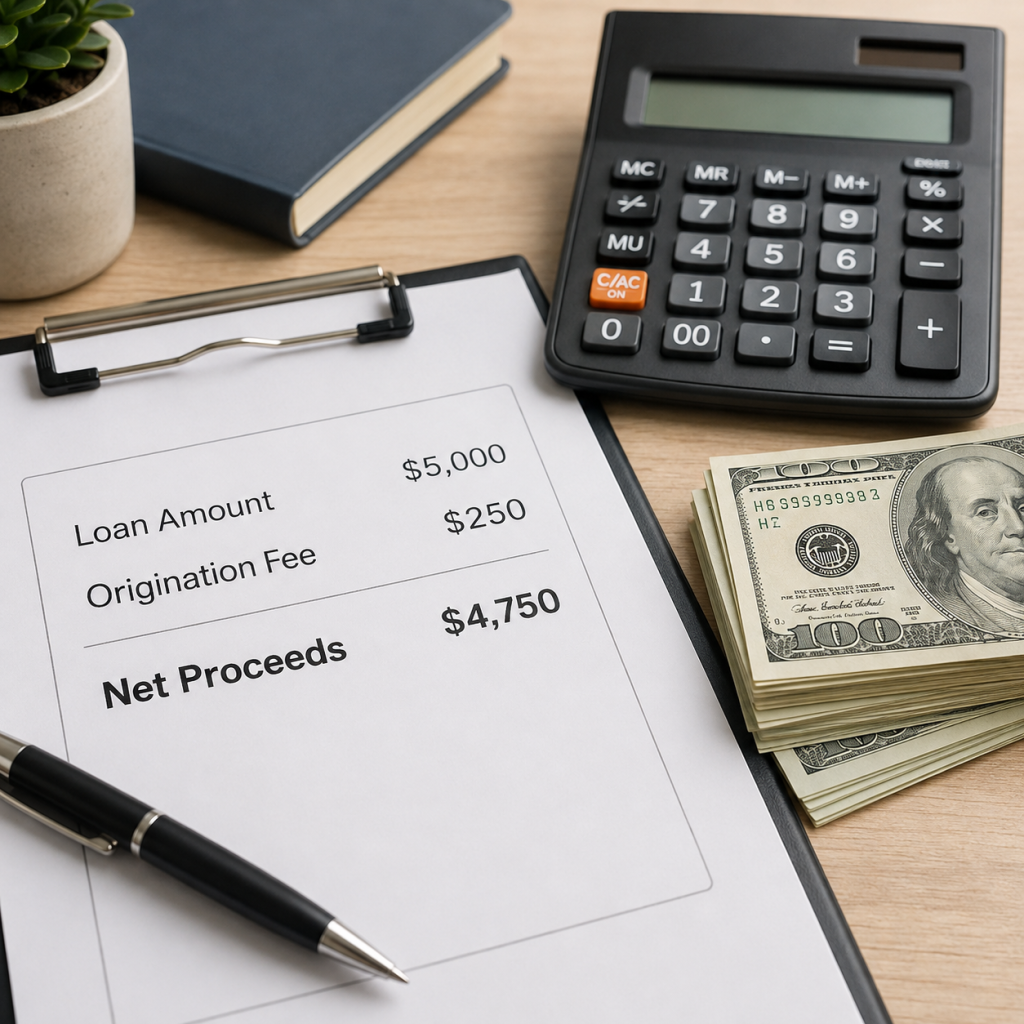
Suppose a lender approves a $5,000 loan and charges a $250 origination fee. If the fee is deducted before funding, only $4,750 reaches your account.
That difference may not matter if you have extra cash available. It matters much more when the loan is supposed to cover an exact $5,000 repair, medical bill, or debt payoff.
This is why the approved amount should never be the only number you check. Look for the amount that will actually be disbursed after required deductions. When comparing different loans, our guide on how to compare personal loan offers explains how fees, APR, repayment terms, and monthly payments work together.
Percentage Fees Can Look Smaller Than They Feel
Origination fees are sometimes shown as a percentage of the loan amount. Converting that percentage into dollars makes the cost easier to understand.
| Loan Amount | Origination Fee | Fee in Dollars | Cash Received if Deducted |
|---|---|---|---|
| $5,000 | 0% | $0 | $5,000 |
| $5,000 | 3% | $150 | $4,850 |
| $5,000 | 5% | $250 | $4,750 |
| $5,000 | 8% | $400 | $4,600 |
These figures are examples rather than standard lender charges. Fees vary by lender and loan product, and some lenders may not charge an origination fee at all.
The important number is not only the percentage. Consider how many dollars the fee removes from the money you expected to receive.
Interest Rate and Origination Fee Measure Different Costs
The interest rate represents the cost of borrowing the principal over time. An origination fee is a separate charge connected with making the loan. A low interest rate does not necessarily mean the overall borrowing cost will be low.
This is one reason APR deserves attention. The Consumer Financial Protection Bureau explains the difference between an interest rate and APR. APR provides a broader measure because it reflects the interest rate together with certain lender fees, including origination charges.
Imagine one offer with a 12% interest rate and a substantial origination fee. Another lender offers 14% interest with no origination fee. The 12% offer is not automatically cheaper because the fee, repayment term, and total repayment amount can change the result.
What Happens When the Fee Is Deducted From the Loan?
When a loan origination fee is deducted before funding, borrowers may see two different numbers: the original loan amount and the cash actually available to spend.
Suppose you borrow $10,000 and the lender deducts a $500 fee before funding. You may receive only $9,500 for the original expense, even though the loan is based on a larger amount.
Before signing, find the answers to three separate questions:
- How much are you borrowing?
- How much will actually be deposited?
- How much will you repay in total?
These numbers serve different purposes. Keeping them separate makes it easier to understand what the loan will actually cost.
Borrowing More to Cover the Fee Can Create Another Cost
A borrower who needs exactly $10,000 might request a larger loan so that enough money remains after the origination fee is deducted.
That may solve the immediate funding gap, but it can create a larger debt. A higher loan balance may increase the monthly payment and the amount of interest paid over time.
For example, requesting $10,500 instead of $10,000 just to offset a fee means that the extra borrowing should also be included in your cost comparison. Do not automatically increase the loan amount without checking what the larger balance will do to your repayment schedule.
This is especially important with urgent borrowing. Our guide on how to compare emergency loan offers looks at net proceeds, funding speed, fees, and repayment costs together.
Why APR Helps When Comparing Offers
APR is particularly useful when two loans combine interest and fees in different ways. A lower advertised interest rate can become less attractive after required fees are included.
As the CFPB explains, APR gives borrowers a broader way to compare borrowing costs. Still, APR should not be the only number you review.
Also compare:
- Monthly payment
- Repayment term
- Net loan proceeds
- Total repayment amount
- Other required fees
- First payment date
A longer repayment term, for example, can make the monthly payment easier to manage. However, it also keeps the debt outstanding for a longer period and may increase the total amount paid.
Looking at these factors together gives you a more complete comparison than choosing the loan with the lowest advertised rate.
A No-Origination-Fee Loan Is Not Automatically the Winner
“No origination fee” can sound attractive, but a fee-free loan is not automatically the least expensive option.
One lender might charge no origination fee but offer a noticeably higher APR. Another lender could charge a moderate fee while providing a lower overall borrowing cost.
The better option depends on the entire agreement. Compare the APR, monthly payment, repayment period, net proceeds, and total repayment instead of making the decision based on one fee.
Advertising that emphasizes “no fees” should not replace a full comparison of the actual loan offer.

Origination Fees Matter More in Debt Consolidation
A deducted origination fee deserves extra attention when a personal loan is being used for debt consolidation.
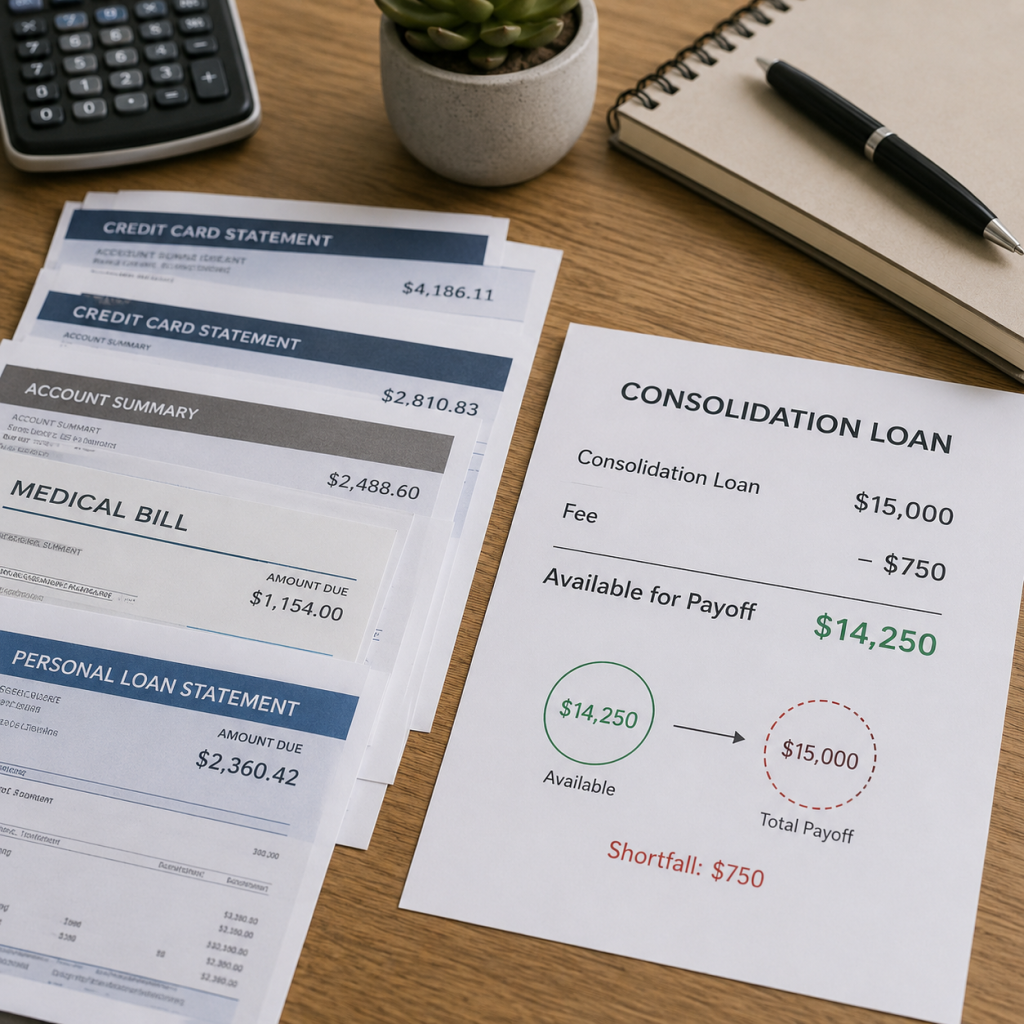
Suppose you owe $15,000 across several accounts and obtain a $15,000 consolidation loan. If the lender deducts a $750 origination fee, only $14,250 may remain to pay the existing creditors.
That creates a problem. You could have a new $15,000 loan while some of the old debt remains unpaid.
The CFPB explains that a debt consolidation loan involves borrowing money to repay separate debts. You then repay the new consolidation loan over time. Because of this, the amount actually available to pay the old balances matters.
If you are new to the strategy, start with our guide to what debt consolidation is and how it works. It explains how several debts can be replaced or reorganized into a new payment arrangement.
Before borrowing, confirm the current payoff amount for each account. Then check whether the net proceeds from the new loan are sufficient after any origination fee is deducted.
After funding, continue checking the old accounts until the payments have posted and the balances are correct. A small remaining balance, additional interest, or processing delay can leave an account open even after a payoff has been sent.
Borrowers comparing several consolidation options can also use our guide on how to compare debt consolidation loan offers.
Do Not Confuse a Disclosed Fee With an Advance-Fee Scam
A disclosed origination fee is different from being unexpectedly asked to send money before a promised loan will be released.
The Federal Trade Commission warns consumers about advance-fee loan scams. Scammers may promise access to credit and then demand money before the borrower receives the loan.
Be especially cautious when someone guarantees approval or pressures you to pay before you can review legitimate loan terms. Requests involving unusual payment methods should also receive extra scrutiny.
Use the lender’s verified website and carefully review the loan agreement before providing sensitive financial information or accepting any charge.
Read the Fee in Context
An origination fee alone does not determine whether a loan is a good or bad choice. A loan with a fee may still provide a competitive APR and reasonable total repayment. A fee-free loan can still be expensive if its rate or repayment structure is less favorable.
Instead of focusing on one number, compare what happens from beginning to end. Check how much money reaches you, what you must pay each month, how long repayment lasts, and how much you will have paid when the debt is finished.
That gives you a much clearer picture than simply looking at the amount printed on the loan approval.