
Compare debt consolidation loan offers by looking beyond the advertised rate. A loan may reduce the number of monthly bills, but not every offer lowers the total cost of debt.
For example, a lower monthly payment may come with a longer loan term. The best advertised rate may not apply to every borrower. In addition, some lenders charge an origination fee, which leaves less money available to pay off existing debts.
For a fair comparison, review the APR, fees, repayment term, monthly payment, net proceeds, and total repayment amount together. Readers who are new to this topic may want to begin with our guide to what debt consolidation is and how it works.
Begin With the Debts You Already Have
Before comparing new loans, create an accurate list of the debts that may be consolidated.
For each account, record:
- Current balance
- Interest rate or APR
- Minimum payment
- Monthly due date
- Remaining repayment period
- Any promotional rate expiration
- Any early payoff conditions
Next, add the balances to estimate how much you need to borrow. Borrow only what is necessary, even if the lender offers more.
Borrowing too much can raise the loan balance and keep you in debt longer. On the other hand, borrowing too little may leave some high-interest debt unpaid.
Compare Debt Consolidation Loan Offers Using the Same Amount
Two offers cannot be compared fairly when they use different loan amounts.
For example, one lender may quote a payment for a loan that covers only part of the borrower’s credit card debt. Another lender may include the full balance. As a result, the smaller loan will naturally appear to have a lower payment.
Therefore, use the same loan amount when comparing offers. If the lender deducts an origination fee, make sure the remaining funds are enough to pay the debts you want to consolidate.
For a broader explanation of side-by-side loan comparisons, review our guide on how to compare personal loan offers.
Look at the Final APR
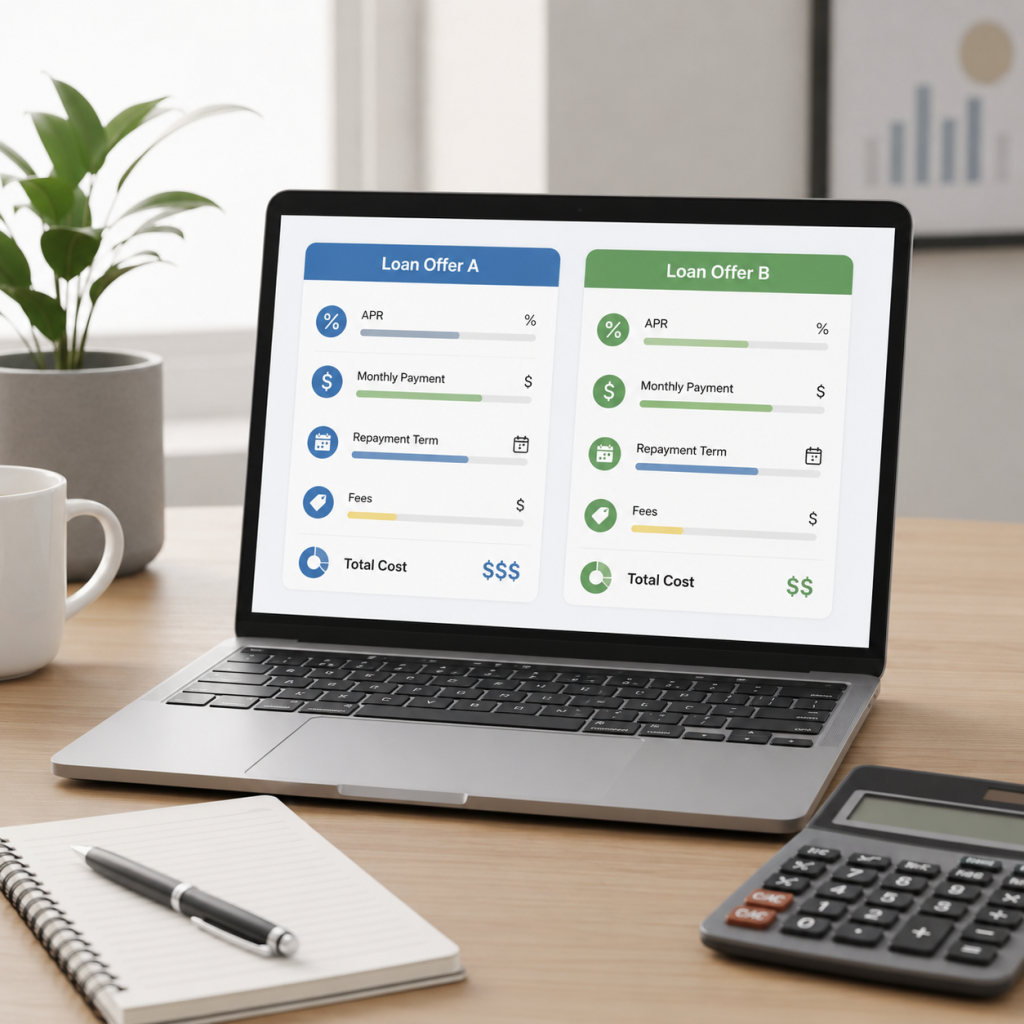
APR is one of the most useful comparison tools because it reflects the yearly cost of borrowing and may include certain lender fees. The Consumer Financial Protection Bureau explains the difference between an interest rate and APR.
However, the advertised rate is not necessarily the rate a borrower will receive. The final APR may depend on factors such as:
- Credit history
- Income
- Existing debt obligations
- Loan amount
- Repayment term
- Whether the loan is secured
- The lender’s underwriting standards
For this reason, compare the APR shown in the actual offer or disclosure, not only the lowest rate displayed in an advertisement.
In general, a lower APR reduces borrowing costs when the loan amount and repayment term are the same. When the terms differ, the total repayment amount must also be reviewed.
Identify the Interest Rate Type
Fixed Interest Rate
A fixed interest rate usually stays the same throughout the loan term. As a result, the monthly payment is often more predictable.
Variable Interest Rate
By contrast, a variable interest rate can change according to the terms of the agreement. The initial rate may be competitive, but later increases could raise the payment or total interest cost.
Borrowers who want stable monthly payments may prefer a fixed-rate loan. In either case, the agreement should clearly explain how the rate is set and whether it can change.
Review the Origination Fee
Some lenders charge an origination fee for processing or issuing the loan. The CFPB also provides an overview of fees that may apply to personal installment loans.
The fee may be:
- Deducted from the loan proceeds
- Added to the loan balance
- Included in the cost calculations
- Charged only to certain borrowers or loan types
For example, suppose a borrower is approved for an amount equal to the debts being consolidated. If the fee is deducted before funding, the borrower may receive less than the amount needed to pay those debts.
As a result, the borrower may need to cover the difference or leave part of the existing debt unpaid.
Always compare the approved loan amount with the net amount that will actually be available.
Compare the Monthly Payment
The monthly payment must fit the borrower’s budget. However, affordability should not be judged by the payment alone.
A lower payment can result from:
- A lower interest rate
- A smaller loan amount
- A longer repayment term
- A payment structure that changes later
Only the first option clearly reduces the cost when the other loan terms remain the same.
Before choosing an offer, write down your monthly bills. Include housing, utilities, food, transportation, insurance, and debt payments.
Then make sure the new loan payment leaves enough money for daily needs. You should not need credit cards to pay for basic costs after making the consolidation payment.
Examine the Repayment Term
The repayment term is the length of time allowed to repay the loan.
- Shorter term: Usually a higher monthly payment, but less interest overall.
- Longer term: Usually a lower monthly payment, but potentially a higher total cost.
Choose a loan term with a monthly payment you can afford. Still, do not focus only on the payment. A longer term can keep you in debt longer and may cost more overall.
When possible, compare several term options. Do not assume that the lender’s longest term is automatically the best choice.
Calculate the Total Repayment Amount
The total repayment amount shows how much the borrower is expected to pay through all scheduled payments.
Compare this figure with:
- The amount borrowed
- The fees charged
- The remaining cost of the existing debts
- The repayment amount under other loan offers
For a basic estimate, multiply the monthly payment by the total number of payments. Then check the loan documents for the exact amount.
Remember that a lower monthly payment does not always mean a cheaper loan. For example, extending the term by several years can increase the total cost.
Check Other Fees and Conditions
Origination fees are not the only possible cost. Therefore, review the agreement for:
- Late payment fees
- Returned payment fees
- Payment processing charges
- Optional service fees
- Prepayment conditions
- Secured loan requirements
- Automatic payment conditions
Some lenders lower the rate when you set up automatic payments. First, check whether the quoted rate includes this discount. Also ask whether the rate will rise if automatic payments end.
In addition, review optional products carefully. A service added to the monthly payment can increase the total cost even when it is not required for approval.

Ask How Creditors Will Be Paid
Some lenders deposit the loan funds into the borrower’s bank account. In that case, the borrower is responsible for paying each creditor.
Other lenders pay creditors directly. This can make the process easier. Even so, the borrower should check that each creditor received the correct amount and updated the account.
Ask:
- Which creditors are eligible for direct payment?
- How long will payment processing take?
- Can the borrower choose the payoff amounts?
- What happens if the creditor balance changes?
- Will any remaining funds be sent to the borrower?
Until each creditor confirms payment, continue making any required payments. Stopping too early could result in a late payment.
Compare Funding Time Carefully
A lender may advertise quick approval or fast funding. However, these terms do not always describe the same stage of the process.
Consider the difference between:
- Receiving a preliminary offer
- Completing the application
- Receiving final approval
- Signing the loan agreement
- The lender releasing funds
- The bank posting the deposit
- Creditors receiving direct payments
Funding may be delayed by missing documents, identity checks, bank processing, weekends, holidays, or an additional review.
Therefore, a borrower facing an upcoming due date should not assume that every debt will be paid immediately after submitting an application.
Understand Prequalification
Some lenders allow borrowers to check possible terms through prequalification.
Prequalification may provide an estimated:
- Loan amount
- APR range
- Repayment term
- Monthly payment
However, these terms may change after the lender verifies the borrower’s income, identity, employment, and credit information. Our guide to personal loan requirements explains several factors lenders may review.
Also confirm whether prequalification uses a soft credit inquiry. A full application may still require a hard inquiry. The CFPB explains the difference between soft and hard credit inquiries.
Checking estimated offers can be useful. Still, submitting several full applications without understanding the credit review process may have consequences. For more context, see how debt consolidation may affect your credit.
Borrowers concerned about qualifying may also review our guide to getting a debt consolidation loan with bad credit.
Evaluate the Lender
Loan terms matter, but borrowers should also evaluate the lender.
Look for:
- Clear contact information
- Transparent rates and fees
- Secure document submission
- A written loan agreement
- An understandable payment schedule
- Clear complaint and customer service procedures
- Licensing or registration information where applicable
By contrast, be cautious when a company guarantees approval, promises to erase debt, demands unusual payment methods, or pressures the borrower to act before reviewing the agreement. The Federal Trade Commission warns consumers about advance-fee loan scams.
A legitimate loan should clearly explain how much is borrowed, how much must be repaid, and when payments are due.
Debt Consolidation Loan Comparison Example
Consider two loans for the same amount.
| Feature | Offer A | Offer B |
|---|---|---|
| Monthly payment | Lower | Higher |
| Origination fee | Yes | No |
| Repayment term | Longer | Shorter |
| Possible advantage | Easier monthly budgeting | Lower total repayment cost |
Neither offer is clearly better. The borrower must decide whether Offer B’s higher payment fits the budget. A payment that is too high could lead to missed payments. At the same time, an unnecessarily long term could increase total interest.
A borrower considering another way to combine card balances can compare a debt consolidation loan versus a balance transfer card.
Use a Debt Consolidation Comparison Checklist
Before accepting an offer, confirm:
- The loan amount covers the intended debts.
- The net proceeds remain sufficient after fees.
- The final APR is clearly disclosed.
- The rate is fixed or variable as expected.
- The monthly payment fits the budget.
- The repayment term is reasonable.
- The total repayment amount has been reviewed.
- All lender fees have been identified.
- The creditor payment process is understood.
- The first payment date is known.
- The consequences of late payment are clear.
- The lender has not made unrealistic promises.

Choose the Offer With the Better Repayment Plan
Debt consolidation should do more than combine several payments into one. More importantly, the new loan should provide an affordable path out of debt.
First, compare debt consolidation loan offers using the same loan amount. Next, review the APR, fees, term, monthly payment, net proceeds, and total cost together. Finally, compare the best new offer with the debts already in place.
A consolidation loan may be useful when it lowers the cost of borrowing or creates a payment plan the borrower can maintain. However, when it only extends the debt or adds substantial fees, keeping the existing repayment plan may be the better choice.
The CFPB’s debt consolidation guidance also notes that combining debts does not erase them and may not always reduce the total amount paid.