
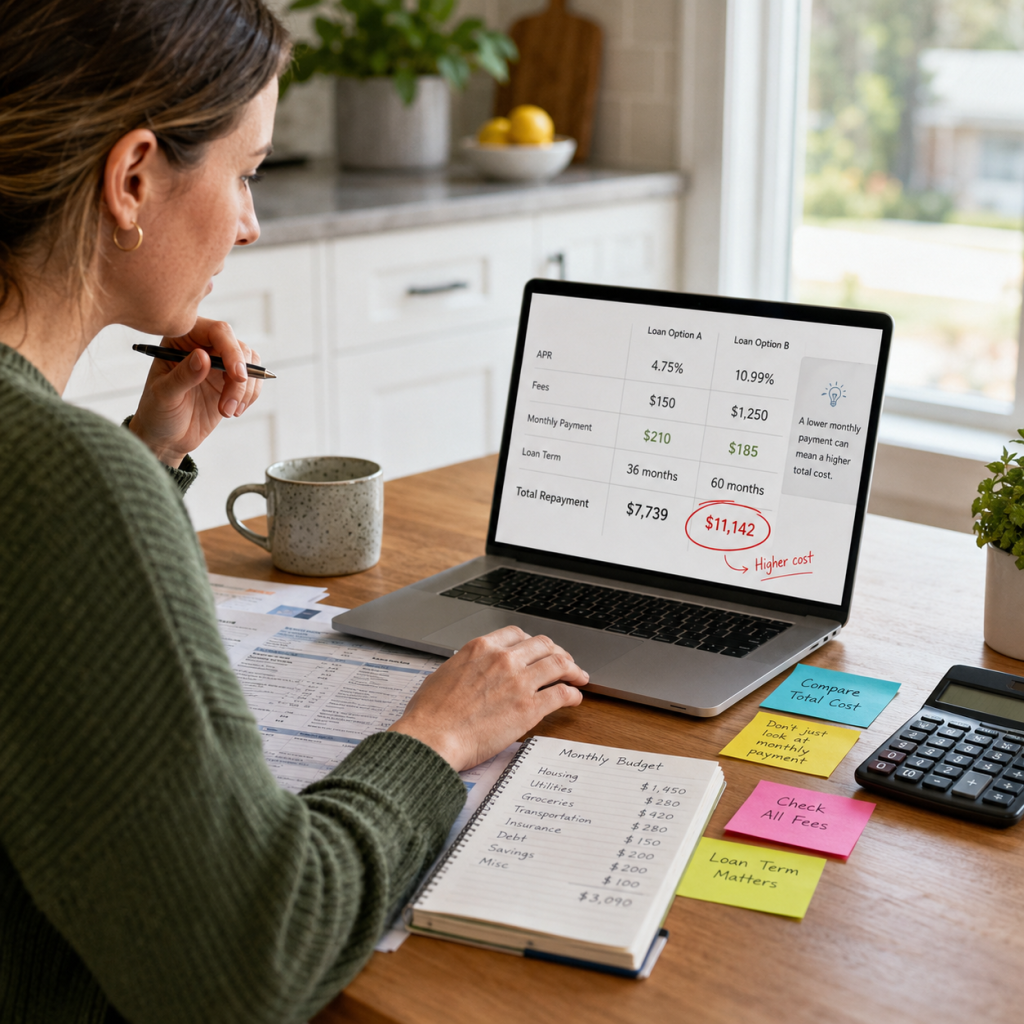
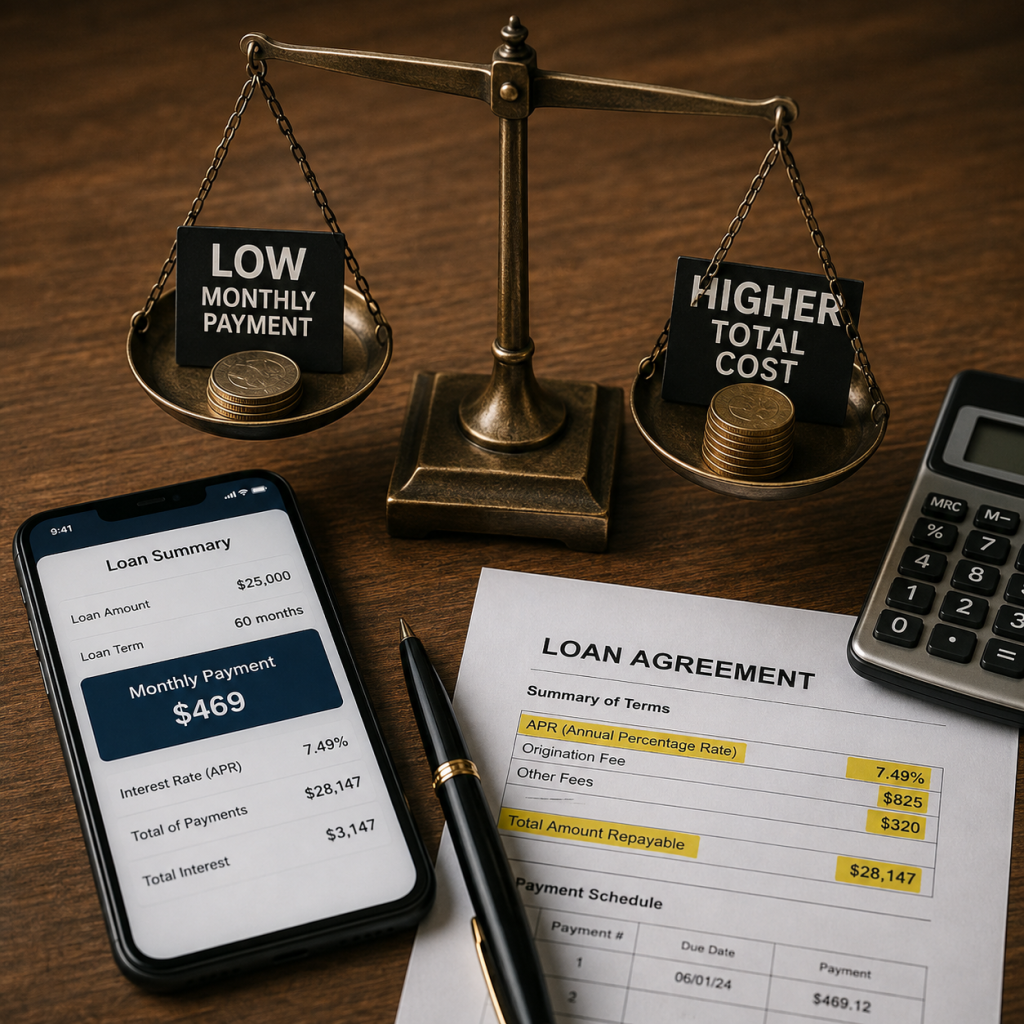
The true cost of a loan is not shown by a single number. A low monthly payment may look affordable, while fees and a long repayment term make the loan more expensive overall.
Before borrowing, review how much cash you will receive, how much you will pay each month, and how much you will repay in total. These figures show whether the loan solves the expense at a reasonable cost.
What Is the true cost of a Loan?
The true cost of a loan includes the interest and required fees connected with borrowing. It also reflects how long the balance remains unpaid.
Important figures include the principal, interest rate, APR, origination fee, monthly payment, repayment term, finance charge, amount received, and total repayment.
Late fees, returned-payment fees, and optional products can increase the cost further. However, those charges may not apply if you make every payment as agreed and decline optional services.
Start With the Principal
Basically, the principal is the loan amount. You’ll get charged interest on this balance as you pay back the loan.
The approved amount and the amount received may not be the same. A lender may deduct an origination fee before sending the funds.
For example, a $5,000 loan with a $250 fee deducted at funding provides only $4,750 in cash. You may still owe payments based on the full $5,000 balance. Our guide to loan origination fees explains how a deducted fee can change the amount you actually receive.
Interest Rate and APR Are Different
The interest rate is the price charged for borrowing the principal. It affects how much interest builds over the repayment period.
APR is a broader comparison figure. It combines the interest rate with certain lender fees and expresses the cost as an annual rate.
A loan with a lower interest rate can have a higher APR if it includes large required fees. For this reason, compare APRs for loans with similar amounts and repayment periods.
Review the Finance Charge
The finance charge shows the cost of consumer credit as a dollar amount. It can make the cost easier to understand than a percentage alone.
Read the disclosure carefully. Check which charges are included and whether any optional products have been added.
Keep in mind that some fees can be avoided. Credit insurance or similar extras might be optional, based on your loan and the law.
Compare the Amount Received
Net proceeds are the funds that reach you after upfront deductions. This amount matters because it is the money available to cover the expense.
Suppose you need exactly $5,000 for a repair. A $5,000 approval with a $300 deducted fee leaves only $4,700. You may need another source of money or a larger loan to close the gap.
The balance also rises when you borrow more for the fee. Before you say yes, make sure what you receive is more than what you give back.
Compare the Loan Cost With the Original Expense
The loan should be compared with the bill or purchase it will cover. A costly loan may not make sense when the creditor, repair shop, medical provider, or utility offers a lower-cost payment plan.
Also consider whether a smaller loan would solve the urgent part of the problem. Reducing the principal can lower the payment, interest, and total amount repaid.
Monthly Payment Does Not Show the Full Cost
A monthly payment answers one question: can the payment fit into the monthly budget? It does not show the entire price of the loan.
Lenders can reduce the monthly payment by extending the term. You may gain more time, but interest can continue for many additional months.
It’s important to have affordable payments. But you should totally check the total paid and how many payments there are, too.
How the Repayment Term Changes the Cost
A shorter term often creates a higher monthly payment. It may also reduce the amount of interest paid over the life of the loan.
A longer term often lowers the payment. However, the loan may remain in your budget for years and may cost more in total.
Do not select the shortest term if the payment would cause missed bills. The goal is to balance monthly affordability with the total cost.

Example: Lower Payment, Higher Total Cost
The following example uses approximate payments for two $5,000 installment loans. It is for education only and is not a lender quote.
| Detail | Loan A | Loan B |
|---|---|---|
| Principal | $5,000 | $5,000 |
| Interest rate | 18% | 16% |
| Origination fee | $0 | $250 deducted |
| Repayment term | 24 months | 36 months |
| Approximate payment | $249.62 | $175.79 |
| Approximate total of payments | $5,990.89 | $6,328.27 |
| Cash received | $5,000 | $4,750 |
Loan B has the lower interest rate and a lower monthly payment. Yet the longer term produces a higher total of payments. The deducted fee also means the borrower receives less cash.
The disclosed APR for Loan B should reflect required lender fees. That APR would be higher than the 16% interest rate shown in the example.
A Simple Four-Step Cost Calculation
You do not need a complex spreadsheet to compare basic offers. Start with four figures from the lender’s disclosure.
- Write down the cash you will receive after upfront deductions.
- Multiply the scheduled payment by the number of payments.
- Add any required amount that must be paid outside the schedule.
- Subtract the cash received from the total amount paid.
The result is a simple estimate of the dollars paid for access to the funds. It may not capture every possible late fee or variable-rate change, but it helps compare offers on the same basis.
Also compare the APR shown in the disclosure. APR is useful because it annualizes the interest and certain required charges.
Fees That May Increase the Cost
- Origination fee: a charge for making or processing the loan.
- Documentation or processing fee: a charge connected with paperwork or account setup.
- Late fee: a charge that may apply after a missed due date.
- Returned-payment fee: a charge after a rejected check or electronic payment.
- Prepayment penalty: a charge that may apply if the agreement limits early payoff.
- Optional insurance or add-on products: extra services that may increase the payment or amount financed.
Ask whether a fee is deducted from the proceeds, added to the balance, or paid separately. The method changes both the amount received and the repayment calculation.
Fixed and Variable Rates
A fixed rate does not change during the stated loan term. This usually makes the scheduled payment easier to predict.
A variable rate can change under the agreement. The payment or repayment cost may rise if the rate increases.
Check the rate type before comparing offers. A low starting rate may not remain low for the full term.
Automatic Payment Discounts Need a Closer Look
Some lenders reduce the rate when you enroll in automatic payments. Compare the discounted terms with the standard terms before accepting.
Confirm whether the discount ends after a failed debit or an account change. Also keep enough money in the payment account before each due date.
An automatic payment can reduce the chance of forgetting, but it does not make an unaffordable payment safer.
Check the First Payment Date
The first payment may arrive sooner than expected. A loan funded near the end of the month can create a short gap before the first due date.
Review the payment schedule before signing. Make sure the first payment does not compete with rent, utilities, insurance, or any other major bill.
Consider the Cost of Missing a Payment
The advertised cost assumes you follow the agreement. A late payment may add fees, increase the amount due, or lead to collection activity.
A returned automatic payment can also cause a bank fee. The debt remains due even when the withdrawal fails.
Do not choose a loan that leaves no room for normal budget changes. A small monthly cushion can reduce the risk of repeated fees.
Refinancing and Debt Consolidation Still Have Costs
A refinance or debt consolidation loan may replace existing balances with a new loan. The new rate may be lower, but the transaction can still include fees and a longer term.
Compare the remaining cost of the current debts with the total cost of the new loan. Do not compare only the old monthly payments with the new payment. For a step-by-step example, see how to calculate whether debt consolidation will save you money.
A longer loan term means smaller monthly payments, but you’ll be paying for longer. The origination fee might also mean less cash for your old debts.
Continue monitoring the old accounts until each payment posts and the balance is confirmed. A transfer delay can create a late payment on an account you expected to be paid off.
Compare Offers Using the Same Measures
Use the same checklist for every offer. Comparing one lender’s APR with another lender’s monthly payment can hide important differences.
- Requested principal
- Cash received after deductions
- Interest rate and APR
- Required fees
- Monthly payment
- Number of payments
- Total of payments
- Finance charge
- Rate type
- First payment date
- Late and returned-payment rules
- Early payoff terms
Questions to Ask Before Signing
- How much money will be deposited into my account?
- Which fees are included in the APR?
- Are any products or services optional?
- Is the interest rate fixed for the entire term?
- What is the total of all scheduled payments?
- Can I repay early without an additional charge?
- What happens if a payment is late or returned?
- Will automatic payment change the rate or fees?
Use the Total Cost to Guide the Decision
The cheapest loan is not always the one with the lowest payment or advertised rate. The better comparison uses the APR, required fees, net proceeds, and total repayment together.