
Does debt consolidation hurt your credit? It may cause a short-term change, but the result is not always negative. Applying for a new loan or credit card may add a hard credit check or a new account.
Paying down card balances and making payments on time may help your credit over time. Missed payments or new balances can have the opposite effect.
The outcome depends on the method used, the borrower’s credit history, and how the new account is managed.

Why There Is No Guaranteed Score Change
Because consumers have more than one credit score, results may vary. Lenders may use different scoring models, credit reporting sources, and score versions.
As a result, no company can accurately promise that debt consolidation will increase a score by a specific number of points.
Credit scores may consider information such as:
- Payment history
- Amounts owed
- Credit card utilization
- Age of credit accounts
- Recent applications
- New accounts
- Types of credit being used
- Delinquencies and collections
Because debt consolidation can affect several areas at once, some changes may be positive while others may be negative.
A Hard Inquiry May Affect Your Credit
When a borrower submits a formal application for a debt consolidation loan or balance transfer card, the lender may review the borrower’s credit report.
This is commonly known as a hard inquiry. Hard inquiries may affect credit scores because they show that the consumer has applied for new credit.
Unlike a hard inquiry, a soft inquiry usually does not affect credit scores. It may happen when consumers check their own credit reports or review possible loan terms before applying.
Before applying, ask how the lender will check your credit. An early rate check may be soft. A full application may still require a hard credit check.
Opening a New Account Can Cause a Change
If the application is approved, the new loan or credit card may be added to the borrower’s credit reports.
Opening a new account can affect:
- The age of the newest account
- The average age of accounts
- The number of recently opened accounts
- The borrower’s credit mix
- The total available revolving credit
The effect may vary because each borrower has a different credit record. Someone with a long record may see a different result from someone with only a few accounts.
A small short-term change does not always mean consolidation was a bad choice. The loan’s total cost and repayment benefits are more important than a temporary change in the credit score.
Paying Down Credit Cards May Reduce Utilization
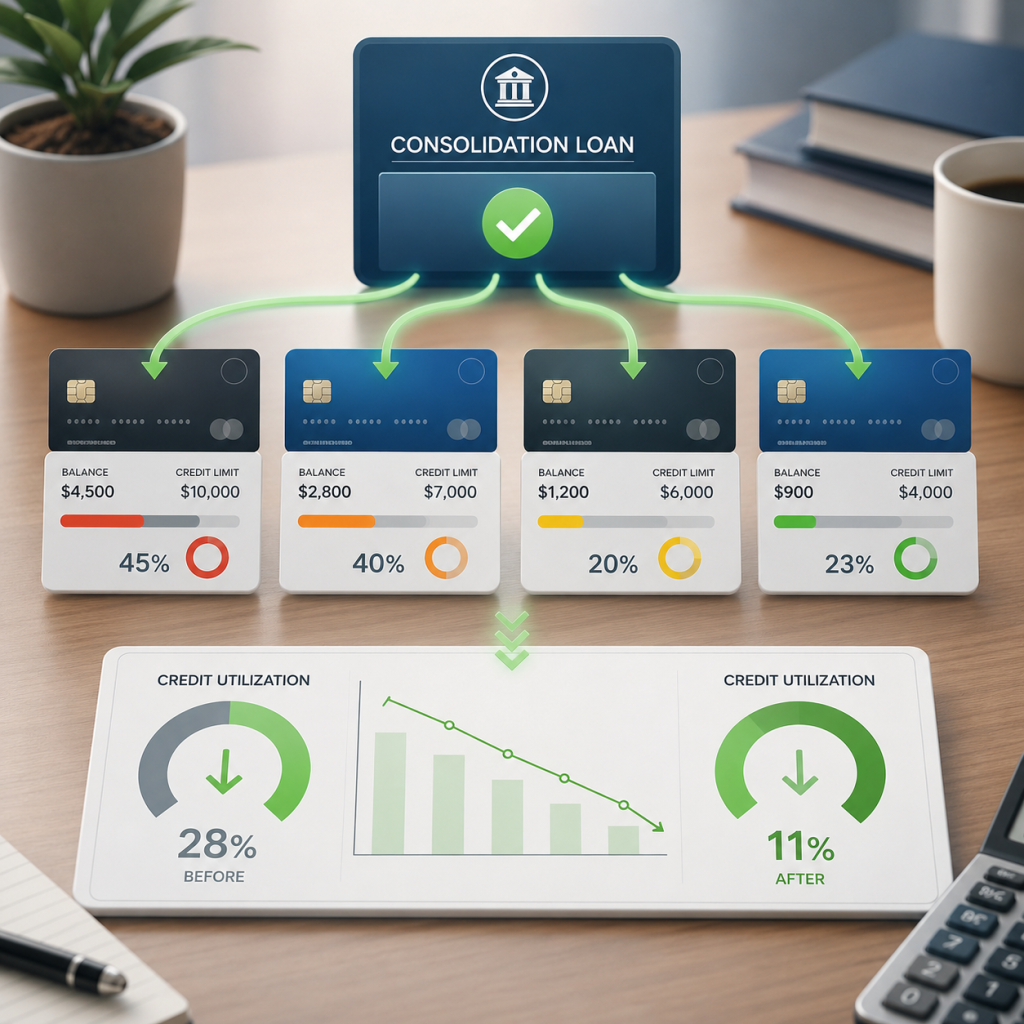
Credit utilization generally compares revolving credit card balances to available credit limits.
For example, using most of your card limits can lead to high credit utilization. Paying off those balances with a consolidation loan may lower the card balances shown on your credit reports.
Over time, lower utilization may support credit scores, depending on the scoring model and the borrower’s overall credit profile.
However, the result may be different when the borrower uses a balance transfer card. The total revolving balance may remain similar, but it is moved to a different card. The new card might also be near its credit limit.
Both overall utilization and utilization on individual accounts may matter.
Closing Paid-Off Cards Can Affect Available Credit
After consolidation, a borrower may consider closing the credit cards that were paid off.
Closing a card can lower your total credit limit. If your balances stay the same, you will be using a larger share of your available credit.
Closing an older account may also affect the credit profile over time, depending on how the account continues to appear on the credit reports and which scoring model is used.
Leaving a card open is not always the correct choice either. An open card may have an annual fee or create a temptation to spend again.
The decision should consider:
- Annual fees
- Account age
- Available credit
- Spending habits
- The card issuer’s conditions
- The borrower’s overall repayment plan
If a paid-off card remains open, the borrower should monitor it for unauthorized activity and review any inactivity policies.
Payment History Remains Important
Debt consolidation still requires on-time payments.
A debt consolidation loan adds a new monthly payment. Late or missed payments may be reported and can hurt the borrower’s credit.
To reduce the risk of missing a payment:
- Confirm the first due date.
- Add the payment to the monthly budget.
- Set calendar reminders.
- Consider automatic payments when appropriate.
- Keep enough money in the payment account.
- Check that each payment was processed.
- Contact the lender promptly if a payment problem occurs.
A predictable installment loan can make payment planning easier, but only when the payment remains affordable.
Old Late Payments Do Not Automatically Disappear
Paying an account through debt consolidation does not usually remove accurate late payments, defaults, or collection information that was previously reported.
The account may be updated to show that the balance was paid, but the earlier payment history may continue to appear according to applicable reporting rules.
Borrowers should be cautious of companies claiming that a consolidation loan will erase accurate negative information immediately.
By contrast, borrowers can dispute credit report information that is inaccurate, incomplete, or not theirs.
Using the Paid-Off Cards Again Can Create New Problems
One of the largest risks after consolidation is rebuilding the credit card balances.
Suppose a borrower uses a personal loan to pay three credit cards. The cards may once again show available credit. If the borrower begins using them for regular expenses, the borrower could end up with:
- The new consolidation loan
- New credit card balances
- Higher monthly obligations
- Rising utilization
- A greater risk of missed payments
Because this outcome can harm both the budget and credit, decide how the paid-off accounts will be handled before consolidating. Some borrowers may stop carrying the cards, remove them from saved online payment methods, or reserve one account for a specific planned expense.
A Balance Transfer Can Affect Credit Differently
A balance transfer card may influence credit in several ways.
When a borrower submits a full application, the lender may make a hard inquiry. If approved, the new card will become a new credit account. The added credit limit may increase the total available credit. However, the transferred balance could still create high utilization on the new card.
Transferring a balance does not eliminate the debt, so the borrower must make progress before the promotional rate expires.
Missing a payment may lead to fees or changes to the promotional terms, depending on the card agreement. If the payment is reported as late, it may hurt the borrower’s credit.
Debt Management Plans Are Different
A debt management plan arranged through a credit counseling organization is not a new debt consolidation loan.
Under the plan, the borrower makes one payment to a credit counseling agency. The agency then pays the creditors in the plan. Some credit card accounts may be closed or restricted.
The effect on credit can vary based on how creditors report the accounts and whether payments are made on time.
Before entering a plan, ask:
- Which accounts must be included?
- Will those accounts be closed?
- How will payments be reported?
- What fees does the organization charge?
- What happens if a payment is missed?
- How long will the plan last?
Debt management should not be confused with debt settlement, where a company may attempt to negotiate payment for less than the amount owed.
How to Limit Unnecessary Credit Impact
Although a borrower cannot control every scoring result, several practical steps can reduce avoidable problems.
Review Credit Reports First
Check the reports for unfamiliar accounts, incorrect balances, or inaccurate payment information before applying.
Use Prequalification Carefully
Ask whether the lender can show possible loan terms with a soft credit check. Review the rate, fees, and monthly payment before you apply.
Avoid Multiple Unnecessary Applications
Compare offers before you apply. Ask each lender how it will check your credit. Applying with several lenders may lead to multiple hard credit checks.
Keep Making Existing Payments
Keep paying the old accounts until each balance shows zero. Loan approval does not mean you can stop those payments right away.
Keep the New Payment Affordable
If the new payment takes up too much of the monthly budget, the risk of late payments and renewed card use may increase.
Avoid New Balances
If paid-off accounts are used again, the long-term benefit of consolidation can disappear.
Monitor All Accounts
Check the original accounts, the new loan, and the credit reports for incorrect balances or reporting issues.
Can Debt Consolidation Improve Credit?
Over time, debt consolidation may support credit when it helps the borrower:
- Reduce credit card utilization
- Make payments on time
- Avoid additional late payments
- Lower outstanding balances
- Maintain a consistent repayment schedule
- Prevent accounts from falling further behind
These outcomes are not automatic and depend on following the new repayment plan while controlling new borrowing.
The main goal is to reduce debt at a cost the borrower can afford. Any improvement in credit should be viewed as a possible benefit, not a guarantee.
When Does Debt Consolidation Hurt Your Credit?
Consider the possible hard inquiry, but judge the loan by its full cost and repayment terms.
One hard inquiry may be worth accepting if the new loan lowers borrowing costs and helps prevent missed payments. However, taking an expensive loan only to improve credit is usually not a good choice.
Compare the financial benefit of the offer with the possible short-term credit impact.

Focus on the Long-Term Repayment Result
So, does debt consolidation hurt your credit? It may cause a short-term change through a hard credit check or a new account. Over time, lower card balances and on-time payments may help improve your credit.
The eventual outcome depends largely on what happens after the consolidation is completed.
Making payments on time, lowering the balance, and avoiding new debt can improve the borrower’s financial and credit position. Missing payments or building up card balances again can make both worse.
For that reason, the best consolidation plan is one that is affordable, clearly understood, and supported by a realistic monthly budget.