
Knowing how to choose a personal loan can help you avoid borrowing more than you need, overlooking fees, or focusing only on the lowest monthly payment. A loan may look affordable at first, but the real cost can depend on the APR, fees, repayment term, lender rules, and whether you can pay the loan off early without extra charges.
Before applying, it helps to understand what you are agreeing to. You can use a personal loan for planned expenses, emergency costs, home repairs, medical bills, debt consolidation, or other major needs. But borrowing more than necessary, choosing a long repayment term, or ignoring fees can make the loan more expensive than expected.
Here are 10 things to check before choosing a personal loan.

1. Decide How Much You Really Need to Borrow
Before comparing loan offers, start with the amount you actually need.
It can be tempting to borrow more if a lender approves you for a higher amount. However, a larger loan usually means more interest over time. Even if the monthly payment looks manageable, the total repayment amount can increase quickly when you borrow more than necessary.
Make a simple list of what the loan will be used for. Then separate the required amount from anything optional. For example, if you need a personal loan for a car repair, medical bill, moving expense, or debt consolidation, calculate the real cost before applying.
A good rule is simple: borrow enough to cover the need, but not so much that the payment becomes difficult to manage.
2. Understand the Difference Between Secured and Unsecured Loans
Personal loans can be secured or unsecured.
An unsecured personal loan does not require collateral. This means you do not have to use your home, car, or another asset to back the loan. Many personal loans offered by banks, credit unions, and online lenders are unsecured.
A secured loan requires collateral. Because the lender has something to claim if the borrower does not repay, secured loans may sometimes offer lower rates. However, they also come with more risk. If you fail to make payments, you could lose the asset used as collateral.
For many borrowers, an unsecured personal loan may be easier and safer, especially when borrowing a moderate amount and trying to avoid putting property at risk. However, the rate you qualify for will usually depend on your credit profile, income, debt level, and lender requirements.
3. Compare APR, Not Just the Interest Rate
The interest rate is important, but APR gives a fuller picture of the loan cost.
APR stands for Annual Percentage Rate. It generally reflects the interest rate plus certain loan costs, such as lender fees. This makes APR useful when comparing one personal loan offer against another.
For example, one lender may advertise a lower interest rate but charge a higher origination fee. Another lender may have a slightly higher interest rate but fewer fees. Looking only at the interest rate could make the first loan seem cheaper, even if the total cost is higher.
When comparing offers, look at the APR side by side. It is one of the easiest ways to compare loan costs more fairly.
For more background, the Consumer Financial Protection Bureau explains that APR reflects the interest rate plus certain additional loan fees, which can make it useful when comparing borrowing costs.
4. Check the Origination Fee and Other Charges
Some personal loans come with an origination fee. This is a fee charged by the lender for processing the loan. It may be deducted from the loan amount before the funds are sent to you.
For example, if you borrow $10,000 and the lender charges a 5% origination fee, you may receive only $9,500, but you may still have to repay the full $10,000 plus interest.
Other possible costs may include:
- Late payment fees
- Returned payment fees
- Administrative fees
- Prepayment penalties
- Optional add-on products
Not every lender charges the same fees. Some lenders advertise no origination fee, while others charge fees based on credit profile, loan amount, or repayment term.
Before accepting a loan, review the full cost, not just the advertised rate.
5. Look at the Monthly Payment and the Total Repayment Amount
A low monthly payment can be helpful, but it does not always mean the loan is cheaper.
Longer repayment terms usually reduce the monthly payment, but they can increase the total amount of interest paid over the life of the loan. Shorter repayment terms may have higher monthly payments, but they often reduce the total interest cost.
For example, a five-year loan may look easier to manage each month than a three-year loan. But if the APR is the same, the longer loan may cost more overall because interest is charged for a longer period.
When comparing personal loan offers, check both numbers:
- The monthly payment
- The total repayment amount
The best loan is not always the one with the lowest payment. It is the one that fits your budget while keeping the total cost reasonable.
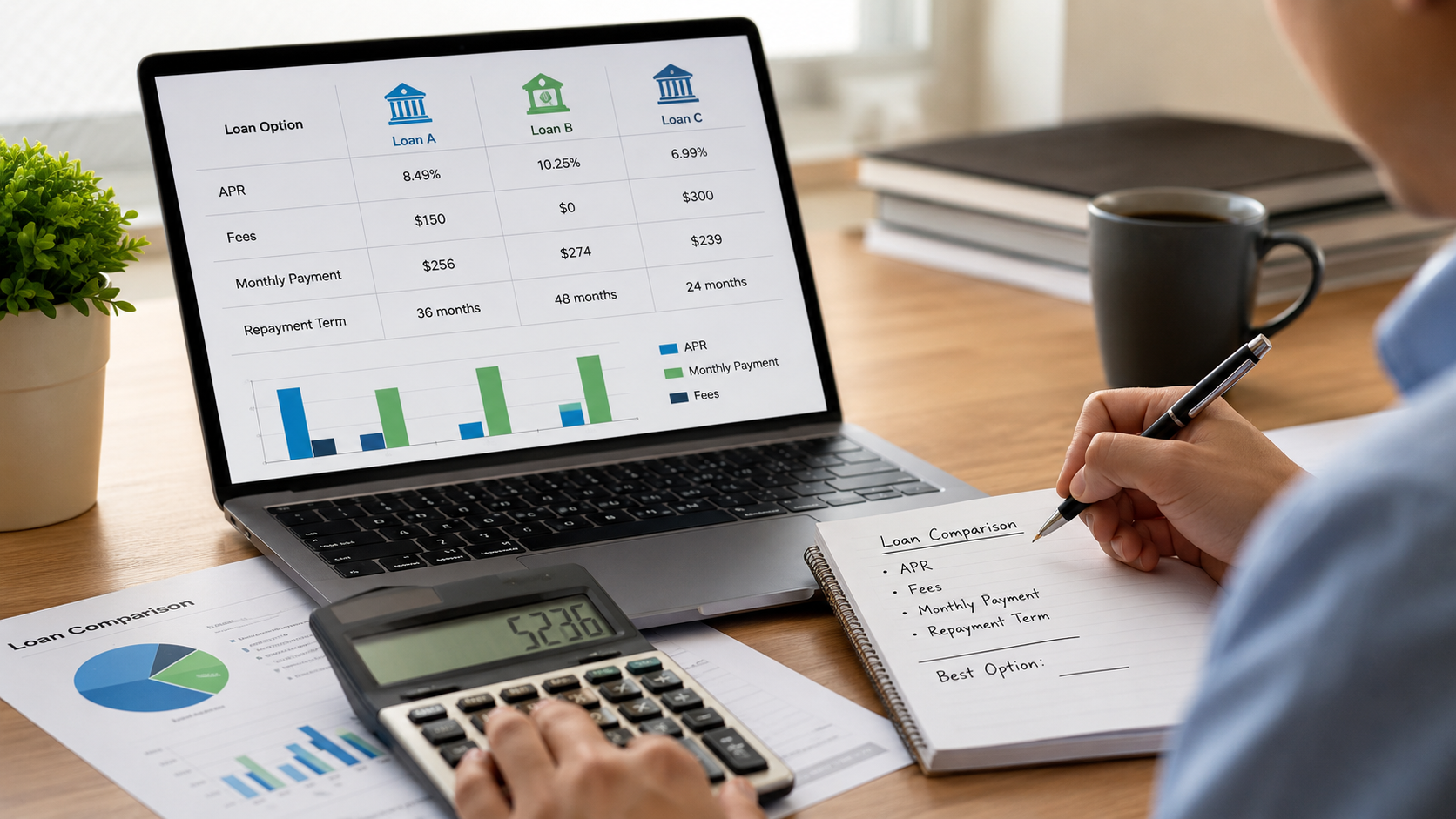
If you already have several loan offers, compare the APR, fees, repayment terms, monthly payments, and total repayment amount side by side before choosing one. You can also read our guide on how to compare personal loan offers.
6. Choose a Repayment Term That Fits Your Budget
The repayment term is how long you have to pay back the loan. Common personal loan terms may range from one to seven years, depending on the lender and loan amount.
A shorter term can help you pay the loan off faster and may reduce total interest. However, the monthly payment will usually be higher.
A longer term may make the monthly payment more comfortable, but it can keep you in debt longer and increase the total cost.
Before choosing a term, look at your monthly budget. Ask yourself whether the payment would still be manageable if your expenses increased or your income changed. A loan payment should not leave you with no room for rent, utilities, insurance, groceries, transportation, or emergency savings.
7. Use Prequalification When Available
Many lenders allow you to prequalify before submitting a full application. Prequalification can show estimated loan amounts, APR ranges, and possible terms based on basic information.
In many cases, prequalification uses a soft credit check, which does not affect your credit score. A full loan application may require a hard credit inquiry, which can have a temporary impact on your credit.
Prequalification is not a final approval. The lender may still verify your income, identity, credit history, and other details before making a final offer. Still, it can be useful because it allows you to compare several lenders before deciding where to apply.
When possible, compare multiple prequalified offers instead of accepting the first one you see.
8. Do Not Rely Only on Advertised Rates
Many lenders advertise a low starting APR, but not every borrower will qualify for that rate.
The rate you receive may depend on several factors, including:
- Credit score
- Credit history
- Income
- Debt-to-income ratio
- Loan amount
- Repayment term
- Employment information
- Whether you apply with a co-borrower or co-signer
This is why an advertised rate should be treated as a starting point, not a promise. A lender may promote a low APR, but your actual offer could be higher after the lender reviews your information.
Before choosing a loan, focus on the offer you actually receive, including APR, fees, payment amount, and repayment term.
9. Watch Out for Upfront-Fee Loan Scams
Be careful with any lender that guarantees approval before reviewing your information or asks you to pay money upfront before receiving the loan.
Warning signs may include:
- Guaranteed approval with no credit check
- Pressure to act immediately
- Requests for payment by gift card, wire transfer, crypto, or unusual methods
- No clear business address or contact information
- Fees required before loan funds are released
- Poorly written emails or suspicious websites
Real lenders may charge fees, but those fees are usually disclosed clearly and handled through the loan process. Be cautious if a company asks you to send money first in order to “unlock” or “release” your loan.
Before applying, check the lender’s website, read the loan disclosures, review customer complaints, and make sure the lender is licensed to operate in your state.
The Federal Trade Commission also warns that companies asking for upfront fees before giving you a loan may be advance-fee loan scams.

10. Check the Early Payoff Rules
Some borrowers want the option to pay off a personal loan early. This can be useful if your income improves, you receive extra money, or you simply want to reduce interest costs.
Before accepting a loan, check whether the lender charges a prepayment penalty. A prepayment penalty is a fee for paying off the loan ahead of schedule.
Many personal loan lenders do not charge prepayment penalties, but you should still confirm this before signing. If you think you may pay extra toward the balance or pay the loan off early, this detail matters.
A loan with no prepayment penalty gives you more flexibility.
What to Compare Before Accepting a Personal Loan
When comparing personal loan offers, look at the same details for each one:
- Loan amount
- APR
- Interest rate
- Origination fee
- Monthly payment
- Repayment term
- Total repayment amount
- Late payment fees
- Prepayment penalty
- Funding speed
- Lender reputation
- Customer support options
Do not choose a loan only because the monthly payment is low or the approval process is fast. A personal loan should be affordable, transparent, and suitable for your actual financial situation.
Before you sign, read the loan agreement carefully. Make sure you understand when payments are due, how much you will repay, what fees may apply, and what happens if you miss a payment.
A personal loan can be helpful when used carefully. Learning how to choose a personal loan means comparing the full cost, avoiding unnecessary borrowing, and choosing a repayment plan that you can realistically manage.