
 Debt consolidation and debt settlement are often mentioned in the same advertisements, but they are not two versions of the same strategy.
Consolidating debt usually means you’ll be paying back your old debts differently. With debt settlement, you’re trying to convince a creditor to settle for less than the full bill. That difference impacts cost, credit risk, collection activity, and what kind of money trouble each option fixes.
Here’s the CFPB’s take on debt consolidation, settlement, and credit counseling. Before you reply to an ad just promising “debt relief,” make sure you get those differences. Understanding debt consolidation vs debt settlement can help you compare the risks, costs, and repayment consequences before choosing a strategy.
Consolidation Changes the Structure of the Debt
With a debt consolidation loan, you borrow new money and use it to repay selected existing debts. You then repay the new loan over time, ideally with a more manageable rate, payment schedule, or number of monthly bills.
The debt is not forgiven. It has been reorganized into a new repayment structure.
While debt consolidation means fewer bills, it doesn’t automatically mean a lower cost. Your new loan might have a different interest rate, charges, and how long you have to pay it back. The CFPB also advises consumers to look over the complete terms before consolidating their credit card debt.
If you are new to the process, our guide to what debt consolidation is and how it works explains the basic structure in more detail.
For someone who can still make regular payments but wants a simpler or less expensive repayment plan, this distinction matters.
Settlement Tries to Reduce What the Creditor Will Accept
Debt settlement works in its own way. The borrower or a settlement company tries to cut a deal with creditors or collectors, rather than just getting a new loan to cover the old ones.
The goal is to have the creditor accept less than the full balance as satisfaction of the debt.
However, a creditor does not have to accept a settlement offer. The settlement company can’t promise everyone will join or that all debts will be lowered.
The CFPB warns that debt settlement programs can be risky and that creditors may refuse to work with a settlement company.
This uncertainty makes settlement different from an approved consolidation loan, where the new loan amount and repayment terms are established before funding.

The Biggest Difference May Appear During the Process
With a consolidation loan, the goal is normally to use the new financing to pay selected old balances. Once those payments clear, the borrower is left with the new consolidation loan to repay.
Debt settlement can involve a very different process.
These programs sometimes suggest pausing payments to creditors while you save for a potential settlement. According to the FTC, halting payments means late fees and penalties can grow, and it can hurt your credit. Collection activity may also continue while the account remains unpaid.
For that reason, an advertisement promising that part of a debt may be forgiven should not be judged only by the potential reduction.
What happens before an agreement is reached matters too.
Side-by-Side: They Solve Different Problems
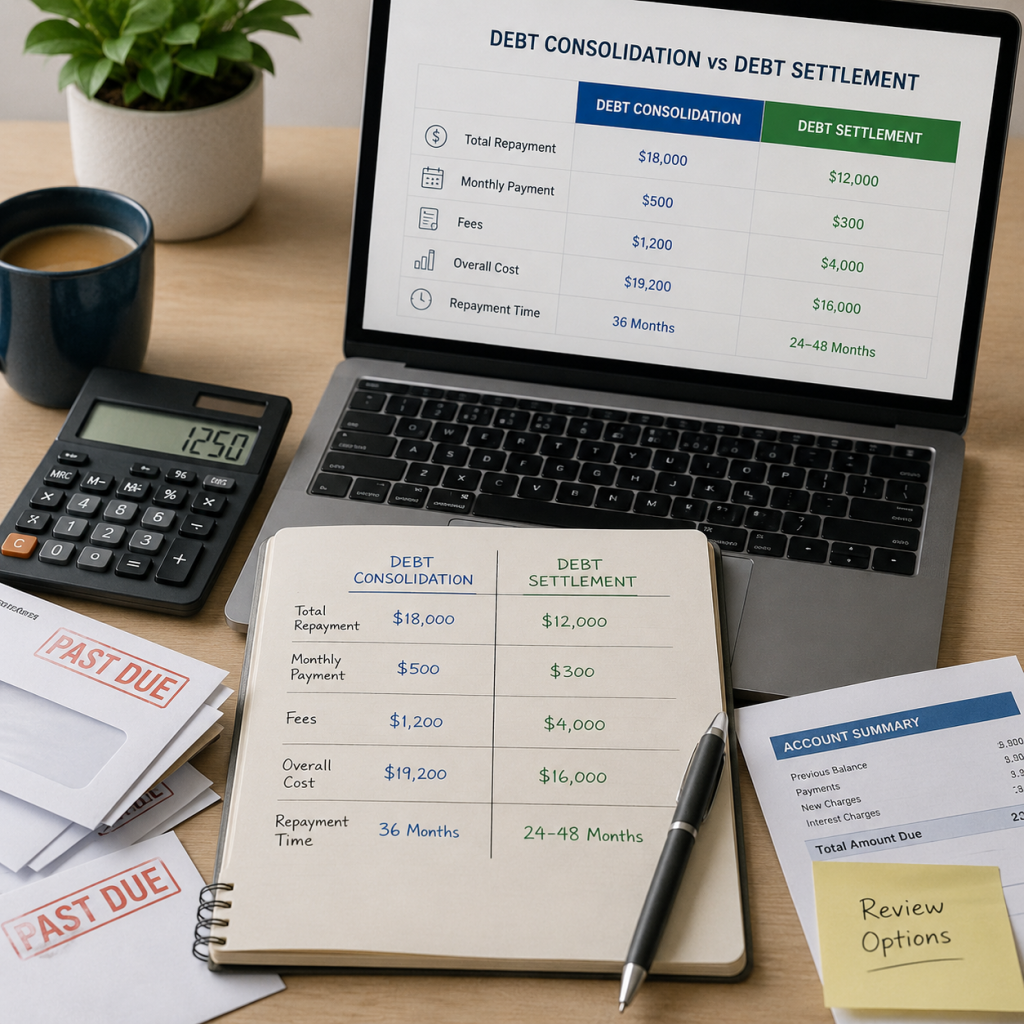
| Issue | Debt Consolidation | Debt Settlement |
|---|---|---|
| Main goal | Replace several debts with a new repayment structure | Negotiate acceptance of less than the full balance |
| New loan required | Often, when using a consolidation loan | Usually no |
| Full original debt repaid | Generally, through proceeds of the new loan | Not necessarily if settlement succeeds |
| Credit qualification | Usually important for obtaining a loan | Different process; loan approval may not be required |
| Creditor agreement | Existing debts are paid if funding is sufficient | Each creditor must agree to a settlement |
| Collection risk | Usually decreases after old accounts are fully paid | May continue or increase while accounts remain unpaid |
| Possible tax issue | Usually not created simply by consolidating debt | Canceled debt may have tax consequences |
The exact outcome depends on the type of debt, lender, creditor, borrower circumstances, and applicable laws.
Why Debt Settlement Can Create Tax Questions
If a creditor cancels part of a debt, the forgiven amount may have federal income tax consequences.
According to the IRS, you might have to report canceled debt as income. The tax outcome is all about your individual circumstances due to important exceptions and exclusions.
Suppose a creditor agrees to settle a $10,000 balance for $6,000. The apparent $4,000 reduction does not necessarily equal $4,000 of financial benefit.
Settlement fees, accumulated interest, and the tax treatment of canceled debt can affect the final result.
Someone considering a substantial settlement may want to review the tax consequences with a qualified tax professional.
Consolidation Can Fail to Save Money Too
Debt consolidation has its own potential problems.
A new loan may reduce the monthly payment simply because repayment is stretched over a longer period. That can improve short-term cash flow while increasing the number of months the borrower remains in debt.
Fees can also affect the calculation. You might have less money to pay off what you owe if the origination fee is taken out first.
For this reason, the useful comparison is not simply:
Old monthly payment vs. new monthly payment
A better comparison is:
Remaining cost of existing debts vs. total cost of the new consolidation loan
APR, fees, repayment term, total repayment, and net proceeds should all be included. Our guide on how to compare debt consolidation loan offers covers these numbers in more detail.
Credit Score Considerations Are Different
A debt consolidation loan may involve a hard credit inquiry and the opening of a new credit account. These events can affect a credit profile, although the result varies from person to person.
Settlement creates a different type of credit risk when accounts become seriously past due during negotiations. Missed payments and delinquent accounts can remain important even if a settlement is eventually reached.
That is why neither strategy should simply be described as “good” or “bad” for credit.
What happens to the accounts before, during, and after the process matters. You can read more in our guide to how debt consolidation can affect your credit.
When Consolidation May Make More Sense
Debt consolidation may deserve a closer look when you can still make regular payments and qualify for terms that improve your current situation.
That improvement might mean a lower APR, fewer due dates, a fixed repayment schedule, or a lower total borrowing cost.
However, replacing five expensive debts with one equally expensive loan does not create much financial improvement. A simpler payment is useful only if the overall numbers also make sense.
If your credit isn’t the best, you’ll want to pay close attention to this. Higher APRs or fees can reduce the benefit of consolidation. Our guide to getting a debt consolidation loan with bad credit explains those additional tradeoffs.
When Settlement Enters the Conversation
Debt settlement is more likely to be considered when repaying the full balances has become difficult or unrealistic.
Even in that situation, settlement does not have to be the automatic next step. Other options may include contacting creditors directly or speaking with a nonprofit credit counselor.
CFPB says credit counseling organizations can help consumers review their finances and may offer debt management plans.
A borrower dealing with lawsuits, insolvency, or several collection accounts may also need legal or tax advice rather than another loan product.
Be Careful With Companies That Blur the Terminology
Some advertisements use phrases such as “debt consolidation,” “debt relief,” and “debt reduction” without clearly explaining what service is actually being offered.
Before providing personal information, determine whether the company is offering:
- A debt consolidation loan
- Debt settlement
- Credit counseling
- A debt management plan
- Another type of debt-relief service
These options operate differently even when the advertising sounds similar.
Fees also deserve close attention. The FTC has rules about when debt-relief companies can charge you, and they’ve told people to watch out for companies asking for money upfront before they help you with your debts.
Read the agreement carefully and make sure you understand what the company will actually do before enrolling.
Choose Based on the Problem You Actually Have
If the main problem is high interest, too many due dates, or an inconvenient repayment structure, consolidation may address that problem.
If full repayment has become unrealistic, the situation may require a different form of debt assistance. Settlement is one possibility, but it carries risks that are very different from taking out a consolidation loan.
The real question is, which one’s the better deal? It’s about whether the plan actually fits the money issue you’ve got.