
What Is a Personal Loan?
A personal installment loan gives you a set amount of money. You repay it through scheduled payments over a fixed period.
With some loans, your payments stay the same, but others might go up or down. Repayment may last for months or even years.
Lenders may review the following details. Our bad credit personal loan requirements guide explains these factors in more detail.
- Credit reports and scores
- Income
- Current debts
- Requested loan amount
- Repayment term
- Bank account activity
- Other application details
Personal loan amounts vary widely. The amount and terms depend on the lender’s rules, your credit, income, and current debts. Read more about how much you can borrow with bad credit.
Bad credit may lead to a smaller loan, a higher APR, or fewer repayment options. An origination fee can also reduce the amount you receive.
What Is a Payday Loan?
A payday loan is a short-term, small-dollar loan.
Many payday loans are due in one payment on the borrower’s next payday. The lender may ask for a postdated check or permission to withdraw the balance electronically from a bank, credit union, or prepaid card account.
A common payday loan limit is around $500, although state laws and lender policies vary. Fees may range from $10 to $30 for each $100 borrowed. A typical two-week loan charging $15 per $100 has an APR of almost 400 percent.
Payday lenders may rely less on traditional credit checks. They often focus on your income and access to a repayment account. Some online lenders may still review your credit report or other consumer data.
Personal Loans vs Payday Loans for Bad Credit
The largest differences involve repayment time, loan size, cost, and how the lender collects payment.
Repayment structure
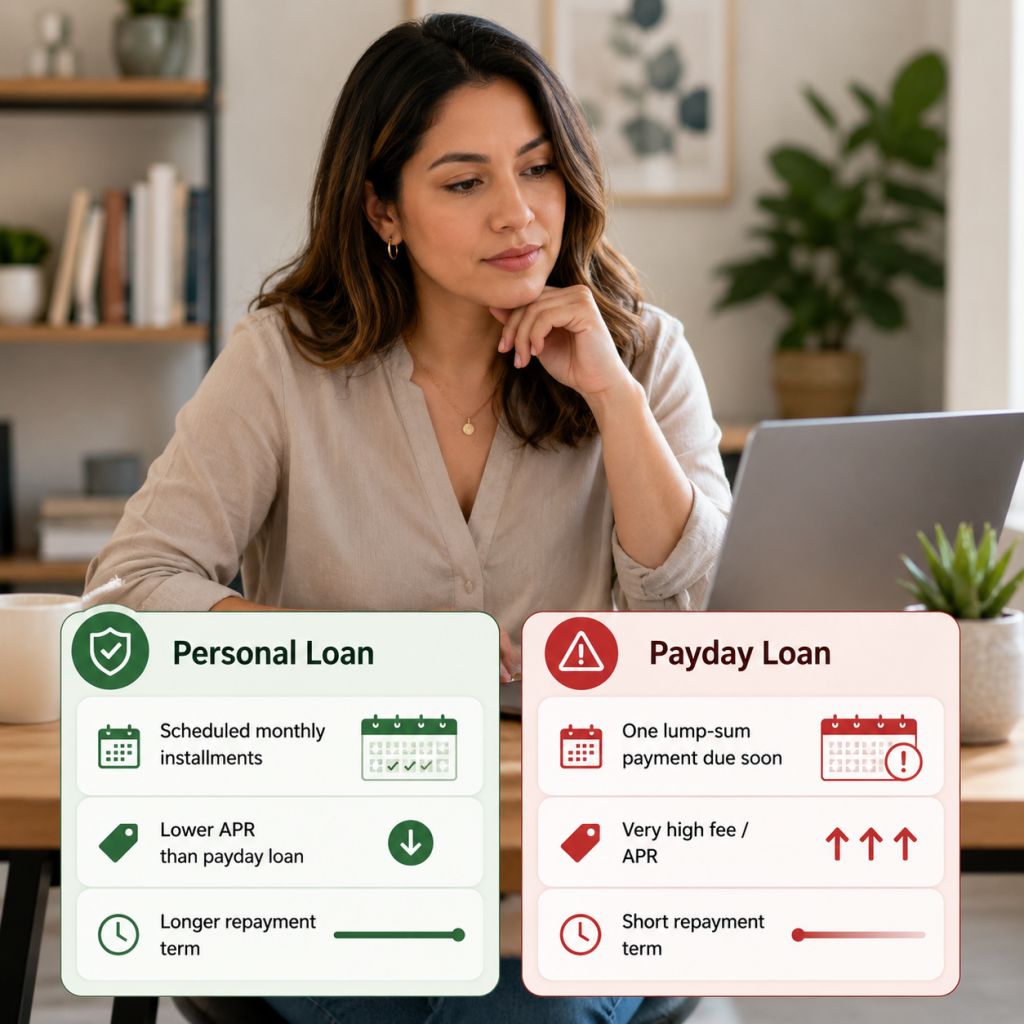
A personal loan normally spreads repayment across several installments.
For example, a borrower might make one monthly payment for 12, 24, or 36 months. This does not make the loan affordable by itself, but it gives the borrower more time to repay the balance.
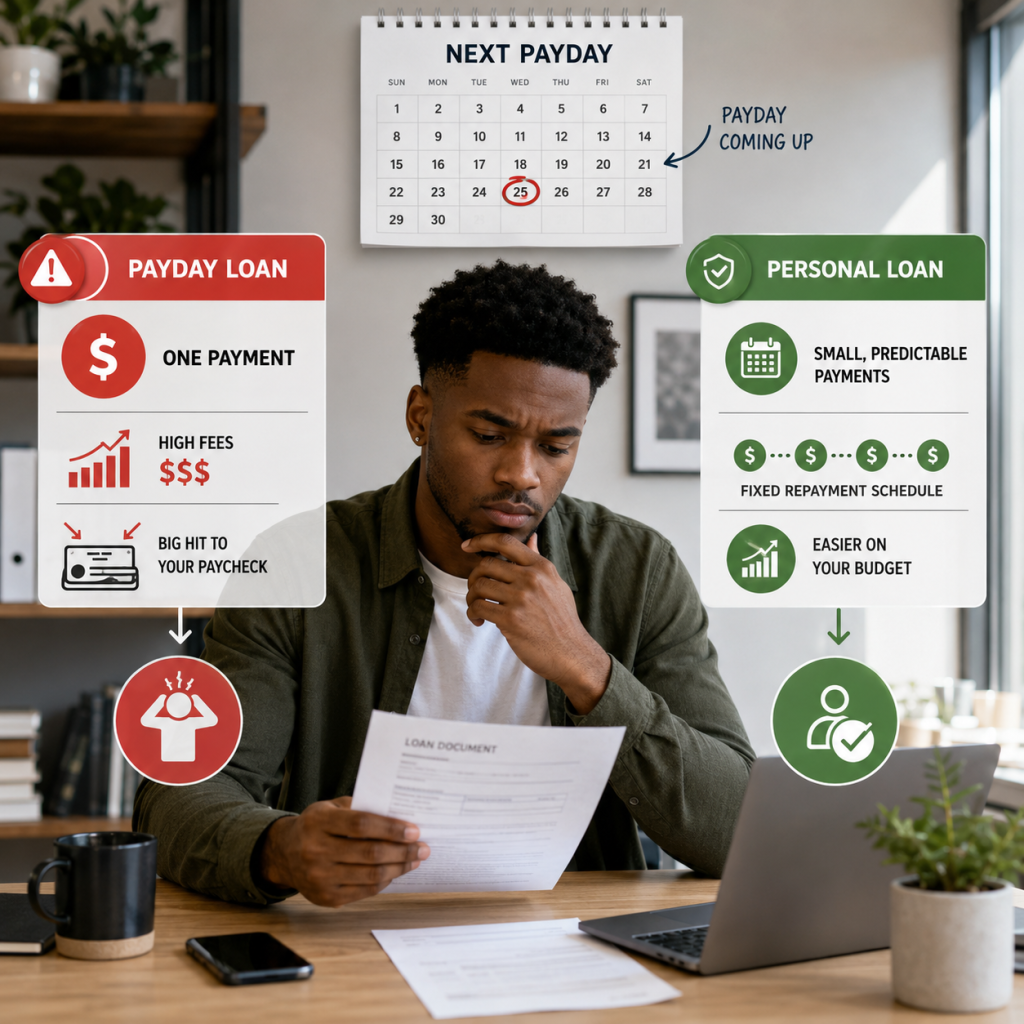
A traditional payday loan may require the full principal and fee in one payment within a few weeks. The payment might take up a significant portion of the borrower’s upcoming wages.
If you cannot repay on time, the lender may offer a rollover where state law allows it. You pay another fee to extend the due date, but the original balance does not decrease. Many states restrict or ban rollovers.
Loan amount
Personal loans may offer larger amounts than payday loans.
The lender may base the amount on income, debts, credit history, requested term, and expected payment. Bad credit may reduce the amount available.
Payday loans usually cover small, urgent expenses. State law may limit the amount you can borrow.
A larger loan is not always better. Borrowing more increases your balance and may raise the total cost.
APR and fees
Cost is one of the most important differences when comparing personal loans vs payday loans for bad credit.
A personal loan may have a high APR when the applicant has weak credit. It may also include an origination fee, a late fee, or another charge. Still, the repayment period is usually longer than a payday loan term.
A payday lender may describe the cost as a dollar fee instead of emphasizing the APR. For example, a $15 charge for every $100 borrowed may sound smaller than an APR near 400 percent. The short repayment period creates a very high annualized rate.
APR includes the interest rate and certain additional loan fees. It is more useful than the interest rate alone when comparing borrowing costs.
Credit review
Personal lenders often check your credit. Applying may add a hard inquiry.
Some lenders let you prequalify for a bad credit loan first. This usually uses a soft inquiry, so it does not affect your credit score. You may see estimated amounts, rates, and payments. A hard inquiry may still happen later.
Payday lenders may use a simpler review. They may still check your income, identity, and bank account. Approval is not guaranteed. Review the likely documents needed for a bad credit loan before submitting sensitive information.
Be cautious with any company that promises guaranteed approval before reviewing the application. Review these predatory loan warning signs before accepting an offer.
Payment timing
Personal loans provide a set schedule. The agreement should show the payment amount, number of payments, due dates, and repayment term.
Payday loans are often due on your next payday. Even a small loan can be difficult to repay within such a short period.
For example, borrowing $500 with a $75 fee could require a $575 payment within a few weeks. The borrower must cover that payment while still paying rent, food, utilities, transportation, and other bills.
Bank account access
A personal loan lender may offer automatic payments, but borrowers should understand the withdrawal date and amount.
Payday lenders often request a postdated check or electronic authorization to withdraw the balance when it becomes due. If the account lacks enough money, the borrower could face lender charges and bank fees.
Federal law generally prevents lenders from requiring recurring automatic electronic payments as a condition of granting most consumer loans. You may stop an automatic payment, but the debt remains.
Credit reporting
A lender may report your payments to one or more credit bureaus. On-time payments may help build a positive payment history when the lender reports them. Late or missed payments may harm the borrower’s credit. The lender may also send an unpaid account to a debt collector.
Payday loans are not a reliable way to rebuild credit. On-time payments may not be reported to the major credit bureaus. However, unpaid debt sent to collections may appear on your credit report.
Quick Comparison
| Feature | Personal loan | Payday loan |
|---|---|---|
| Typical repayment | Multiple installments | Often one lump-sum payment |
| Loan term | Months or years | Often a few weeks |
| Loan amount | May range from hundreds to thousands | Usually a smaller amount |
| Credit review | Often includes credit and income | Often focuses on income and account access |
| Cost | Varies by lender and credit profile | Frequently very high APR |
| Payment reporting | May report to credit bureaus | Rarely builds credit |
| Main risk | Long repayment and high total cost | Large near-term payment and repeated fees |
The exact terms depend on the lender, loan product, and state law.
Is a Personal Loan Always the Better Choice?
Not necessarily.
A bad-credit personal loan may still be expensive. A high APR, large origination fee, or long repayment term can make the total cost difficult to manage.
Some personal loan offers may also be too small to solve the expense. Others may create a monthly payment that competes with essential bills.
Before accepting a personal loan, check:
- The APR
- Origination fee
- Amount received after fees
- Monthly payment
- Number of payments
- Total repayment
- Late-payment policy
- Whether payments are reported
- Whether there is a prepayment penalty
The repayment schedule may be easier to manage than a single payday loan payment, but the full cost still matters.
Why Can a Payday Loan Become Difficult to Repay?
A payday loan may appear manageable because the original amount is small.
The problem often appears on the due date. The borrower must repay the full balance while covering regular living costs from the same paycheck.
When rollovers are allowed, a borrower can pay an extra fee to delay repayment. That payment does not reduce the principal. Repeated renewals can make the total fees much larger than expected.
Rollovers are not available everywhere, and they should not be treated as a repayment plan.
Some states require extended payment plans in certain situations, but eligibility, fees, and other rules vary. If payment is becoming difficult, review the CFPB’s guidance on what to do when you cannot repay a payday loan.
Which One Is Easier to Qualify For With Bad Credit?
A payday loan may appear easier to obtain because the lender may not rely heavily on a traditional credit score.
However, easier approval can come with a much shorter repayment period and a higher borrowing cost.
A personal loan may require a stronger application. The lender may review income, credit history, debt level, and the requested amount. Some lenders may still consider applicants with bad credit, but the offer may include a higher APR or a smaller balance.
When comparing personal loans vs payday loans for bad credit, do not treat easy approval as the same thing as a useful loan.
The better option is the one that provides enough money, has clear terms, and creates a payment you can realistically manage.
Questions to Ask Before Accepting Either Loan
Before signing, ask the lender:
- How much money will I receive after fees?
- What is the APR?
- How much is each payment?
- When is the first payment due?
- Is the balance due all at once?
- What is the total repayment amount?
- What happens if I cannot pay on time?
- Can the lender withdraw money from my account?
- Are payments reported to credit bureaus?
- Is an extended payment plan available?
- Does the lender operate legally in my state?
Do not rely only on the advertised payment or approval amount. Review the written agreement.
Consider Other Options Before a Payday Loan
Before choosing a payday loan, compare alternatives that may provide more time or lower costs.
Possible options include:
- Asking the creditor for a payment extension
- Requesting a utility or medical payment plan
- Checking a credit union small-dollar loan
- Asking an existing bank about available credit
- Comparing soft-inquiry personal loan prequalification
- Seeking help from a nonprofit credit counselor
- Using local emergency assistance
- Borrowing a smaller amount from a trusted person with a written repayment plan
No option is guaranteed. Compare several sources before choosing a loan. This may help you avoid an expensive offer.
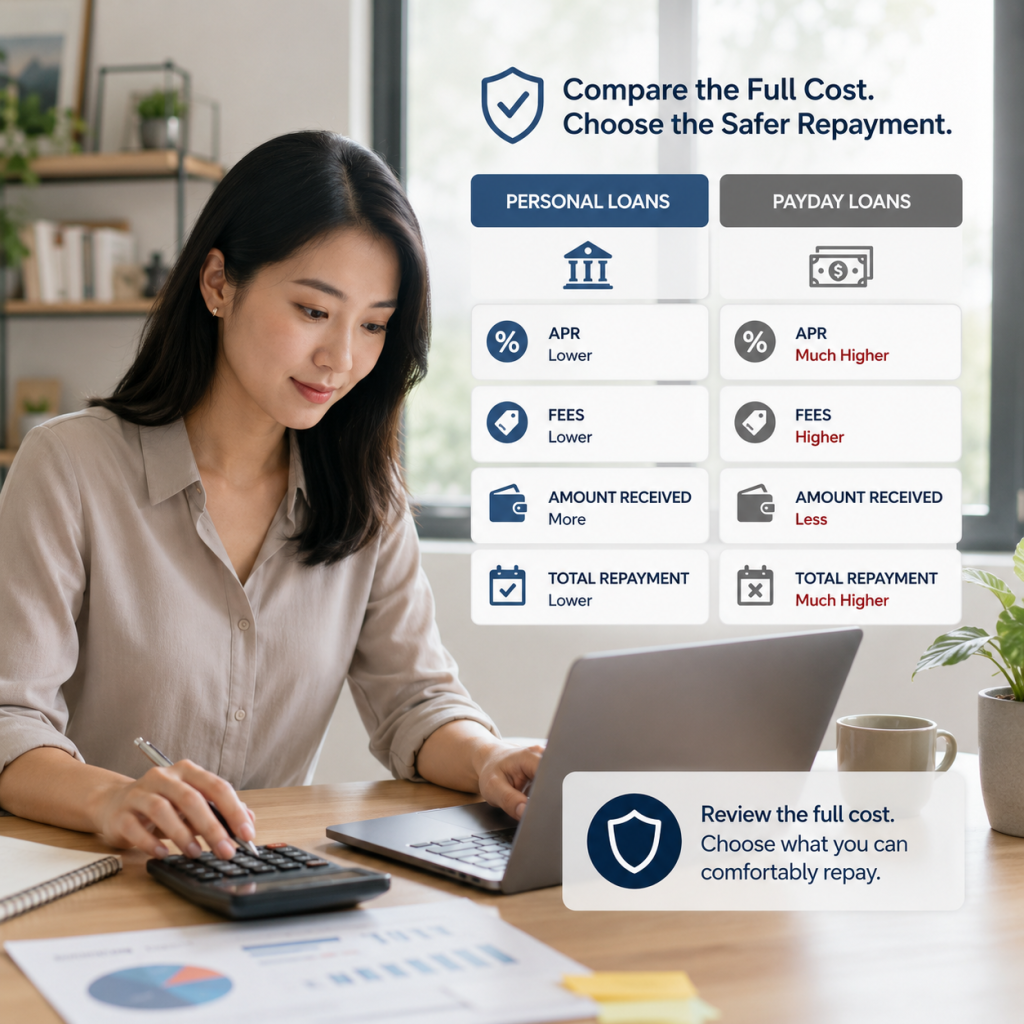
Choose the Repayment Structure You Can Manage
The main difference between personal loans vs payday loans for bad credit is not simply the approval process.
Personal loans use scheduled payments. Payday loans are often due within a few weeks. They may also charge high fees, even for a small loan.
Reviewing the complete cost is necessary before accepting either option. Check how much money you will receive, when repayment begins, and what your budget will look like after each payment.
A loan should solve the current expense without forcing you to borrow again when the next bill or paycheck arrives. Before signing, consider whether you should use a personal loan at all.