
How much can you borrow with bad credit? There is no fixed limit. The amount depends on your income, current debts, credit history, requested loan amount, and the lender’s approval rules. One lender may offer a small personal loan, while another may decline the same application. The amount depends on your full financial profile and the lender’s approval rules.
When people ask how much they can borrow with bad credit, the most accurate answer is that the lender will compare the requested amount with their income, current debts, credit history, and expected monthly payment. Your state and the type of loan may also affect the amount.
The maximum shown in an advertisement is not a promise. It may apply only to applicants who meet stronger credit and income standards. Focus on the amount offered to you and whether the payment fits your budget. A broader borrowing checklist can also help you decide whether the loan is appropriate.
Is There a Standard Loan Limit for Bad Credit?
There is no universal personal loan limit for borrowers with bad credit.
Each lender sets its own loan limits. It also decides how much each applicant may receive. Two people with similar credit scores can still get different offers. Their income, debts, payment history, and requested loan terms may be different.
A credit score helps lenders estimate how likely a borrower is to repay on time. However, you do not have only one score. Scores may vary by scoring model, credit bureau, financial product, and calculation date. A lender may also review the credit report instead of relying on one number alone.
As a result, a website that advertises loans “up to $25,000” does not necessarily offer that amount to every applicant. The lender may approve less, change the repayment term, charge a higher APR, or deny the application.

What Determines How Much You Can Borrow With Bad Credit?
Lenders review several factors before deciding how much to offer. No single detail determines the final loan amount.
Your income
Income is one factor that may affect how much you can borrow with bad credit.
A lender may check how much income you receive, how often it arrives, and whether it is stable. The lender may also ask for proof. Accepted income can include wages, self-employment earnings, retirement income, and other lawful sources.
A higher income may help, but it does not guarantee a larger loan. Lenders also compare your income with your current debts and other obligations.
Your monthly debts
Current debt payments reduce the amount available for another loan.
A lender may review your credit card, car loan, student loan, mortgage, and other monthly debt payments. It may use these amounts to calculate your debt-to-income ratio, or DTI.
DTI compares your total monthly debt payments with your gross monthly income. Lenders may use it to judge whether you can manage another payment. Each lender may apply its own DTI limit.
For example, two applicants may each earn $4,000 per month. One pays $600 toward current debts, while the other pays $1,800. The first applicant may have more room for a new payment, even if both have similar credit scores.
Your credit report
The details behind your score may influence the amount offered.
A lender may review:
Recent missed payments
Collection accounts
Credit card balances
Current installment loans
Charge-offs or defaults
Recent credit applications
The age of negative information
Your recent payment pattern
An older credit problem may be viewed differently from several recent missed payments. A lender may also notice that balances have fallen or that recent accounts are being paid on time.
The amount you request
The requested amount affects the lender’s decision.
A $2,000 request may produce a different result from a $15,000 request. The lender may decide that your budget supports the smaller payment but not the larger one.
In some cases, the lender may approve less than you requested. That does not mean the smaller offer is affordable. You still need to check the APR, fees, loan term, and total repayment.
The repayment term
The loan term changes the monthly payment.
A longer term may reduce the payment, which can make a larger balance appear more manageable. However, a longer schedule may also increase the total interest paid.
A shorter term may reduce the overall cost, but the monthly payment could be much higher. The lender may limit the amount when the available terms would create a payment that is too large.
The lender’s risk rules
Lenders do not evaluate risk in exactly the same way.
One lender may focus heavily on credit score. Another may place more weight on income, recent payment behavior, or debt level.
Risk-based pricing may also lead to less favorable terms, such as a higher interest rate. This decision can be based on your credit score, employment status, income, debts, and other factors.
This is why the answer to how much you can borrow with bad credit may change from one lender to another.
Does a Higher Credit Score Increase the Loan Amount?
A stronger score may improve access to credit, but it does not set the loan amount by itself.
Higher scores make it easier to qualify and may lead to better rates or terms. Lenders also use credit scores to help determine the interest rate and credit limit offered.
Still, a borrower with strong credit and high monthly debts may receive a smaller offer than expected. A borrower with lower credit but steady income and limited debt may qualify for a useful amount from some lenders.
Credit is only one part of the application. Lenders also consider your income, current debts, requested amount, and expected monthly payment.
How Much Should You Ask to Borrow?
Start with the expense, not the lender’s advertised maximum.
Calculate the amount needed to cover the actual purpose of the loan. Then check whether an origination fee will be deducted from the proceeds.
For example, suppose you need $4,000 and the lender deducts a fee before funding. A $4,000 approval may leave you with less than $4,000 in your bank account.
Personal installment loans may charge fees, including an origination fee. The CFPB recommends reviewing the lender’s disclosures so you know what you may have to pay.
Borrowing extra increases both the loan balance and the total repayment cost. Still, borrowing too little may leave part of the original expense unpaid.
A practical request should cover the need, account for disclosed fees, and produce a payment your budget can support.
Estimate the Payment Before Choosing an Amount
The approved balance is only one part of the decision.
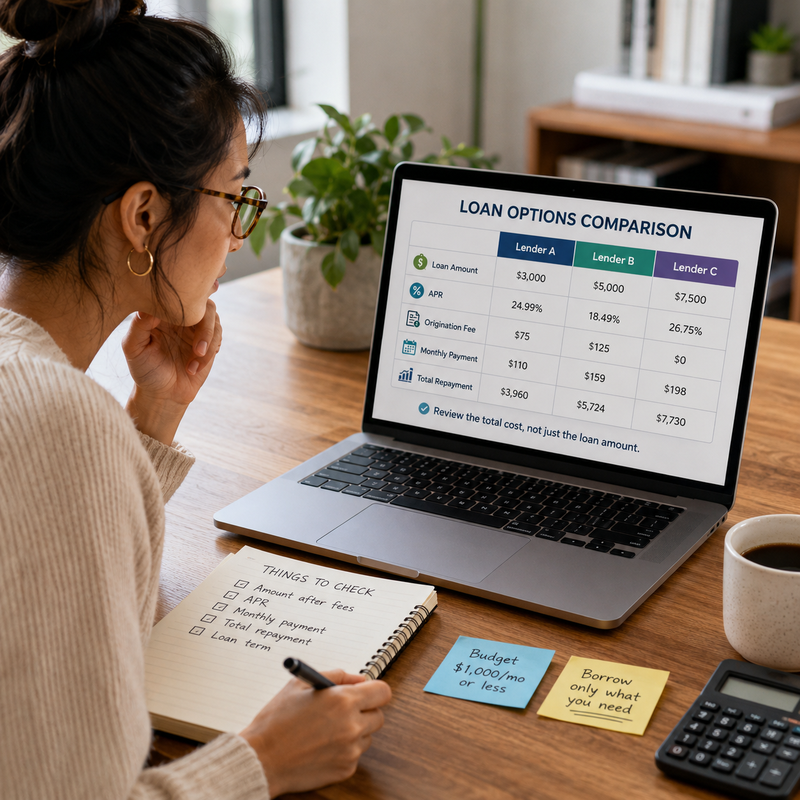
Review:
APR
Origination fee
Amount received after fees
Monthly payment
Number of payments
Total repayment
First payment date
Late-payment terms
APR is especially useful because it combines the interest rate with certain lender fees. It gives a broader view of borrowing cost than the interest rate alone.
Suppose one lender offers more money but also charges a higher APR and a longer term. The larger approval may look helpful at first, but it could create a payment schedule that lasts much longer than the expense it covers.
Do not judge affordability by the first payment alone. Make sure the payment still fits after covering rent, utilities, food, insurance, transportation, and existing debts.
Can Prequalification Show Your Possible Loan Amount?
Prequalification may give you an estimate of how much you can borrow with bad credit before a formal application.
Some lenders use a soft inquiry during this stage. The result may include a loan range, APR, term, fee, and monthly payment. However, the estimate is not final.
The amount may change after the lender verifies income, reviews documents, confirms identity, or completes a hard credit inquiry.
You may also review the documents needed for a bad credit loan before moving to a formal application.
For more detail, see Can You Prequalify for a Bad Credit Loan Without Hurting Your Credit?
Use prequalification to compare possible offers. The highest estimate may be more than you need or can afford.
Could a Co-Borrower or Collateral Increase the Amount?
Some lenders allow a co-borrower, co-signer, or secured loan.
A co-borrower with stronger income or credit may improve the application. However, both people become responsible for the loan, and missed payments can affect them both.
A secured loan uses an accepted asset as collateral. The asset may reduce the lender’s risk and could affect the amount or rate offered.
The tradeoff is serious. The lender may take the pledged asset if the loan is not repaid.
Do not add a co-borrower or pledge an essential asset just to qualify for more money. Understand the repayment duty and loss before signing.
Why Might a Lender Offer Less Than You Requested?
A smaller offer may mean the lender believes the requested amount would create too much risk or too large a payment.
Possible reasons include:
The income is too low for the requested payment
Existing debts are high
Recent missed payments appear on the credit report
The requested term is not available
The lender has a lower internal limit
Information could not be verified
The application does not meet state or product rules
If the revised amount does not solve the original problem, do not accept it automatically. Borrowing part of the money may leave you with both the original expense and a new loan payment.
What If the Application Is Denied?
A denial from one lender does not prove that every lender will deny the application. Approval standards vary.
Avoid submitting several formal applications at once, since each one may add a hard inquiry. Review the denial reason before applying again.
When a lender denies a credit application, it must provide the main reasons or explain how you can obtain them.
The reason may show that you need to:
Correct an error on your credit report
Request a smaller amount
Reduce an existing balance
Provide verifiable information
Wait until recent payments are reflected
Consider a different source of funding
Before applying again, confirm whether the next lender offers soft-inquiry prequalification.
Signs That the Amount May Be Too High
A lender may approve more than your budget can safely carry.
Pause before accepting when:
The payment uses nearly all remaining monthly income
You would need another loan to make payments
Essential bills would be delayed
The term is extended mainly to lower the payment
The amount includes money you do not need
Fees greatly reduce the cash you receive
One missed paycheck would cause immediate trouble
For broader lender and application risks, review predatory loan warning signs for bad credit borrowers.
Approval is a lending decision, not a complete household budget review.

Borrow Based on Need, Not the Maximum
How much can you borrow with bad credit depends on the lender, but the better question is how much you can repay without disrupting essential expenses?
Compare several realistic options when possible. Focus on the amount you will receive after fees, then check whether the monthly payment and total cost fit your budget.
A smaller loan with clear terms may be safer than a larger offer with years of difficult payments. Borrow only enough to solve the immediate problem without creating another financial burden. Ultimately, how much you can borrow with bad credit matters less than how much you can safely repay.